
Something Good #128: Respect, Admiration, and Trust Equals Love
"I'll marry you if you admit that respect, admiration, and trust equals love."


This year I wanted to do something for my birthday, so I decided to rent out a little movie theatre around the corner and show a film that meant something to me. But what movie, and how?
Before I could answer the first question, I needed to know the limits of the possibility space. To show a movie in public, you need to obtain a license, for some amount of money, from whoever owns the rights in your territory. I found a company in Canada, confusingly called Criterion Pictures Canada (no relation to the Criterion Collection), with an early-2000s-vintage website that featured an appealing call to action: “Interested in bringing Hollywood's greatest films to your School, College, University, Recreation Centre, Library, Museum, Art Gallery, Hospital, Hotel, Prison, or on your Bus Lines?”
I downloaded their catalog in the form of a file named criterion_titles.pdf, a 477-page-document that appeared to have been hand-typed, featuring an uncountable number of titles ranging from 1,000 Times Good Night (111 mins, 2013, rated 14A) to The Zwickys (105 mins, 2014, Not Rated). I sifted through it until I found it—the film I needed to show.
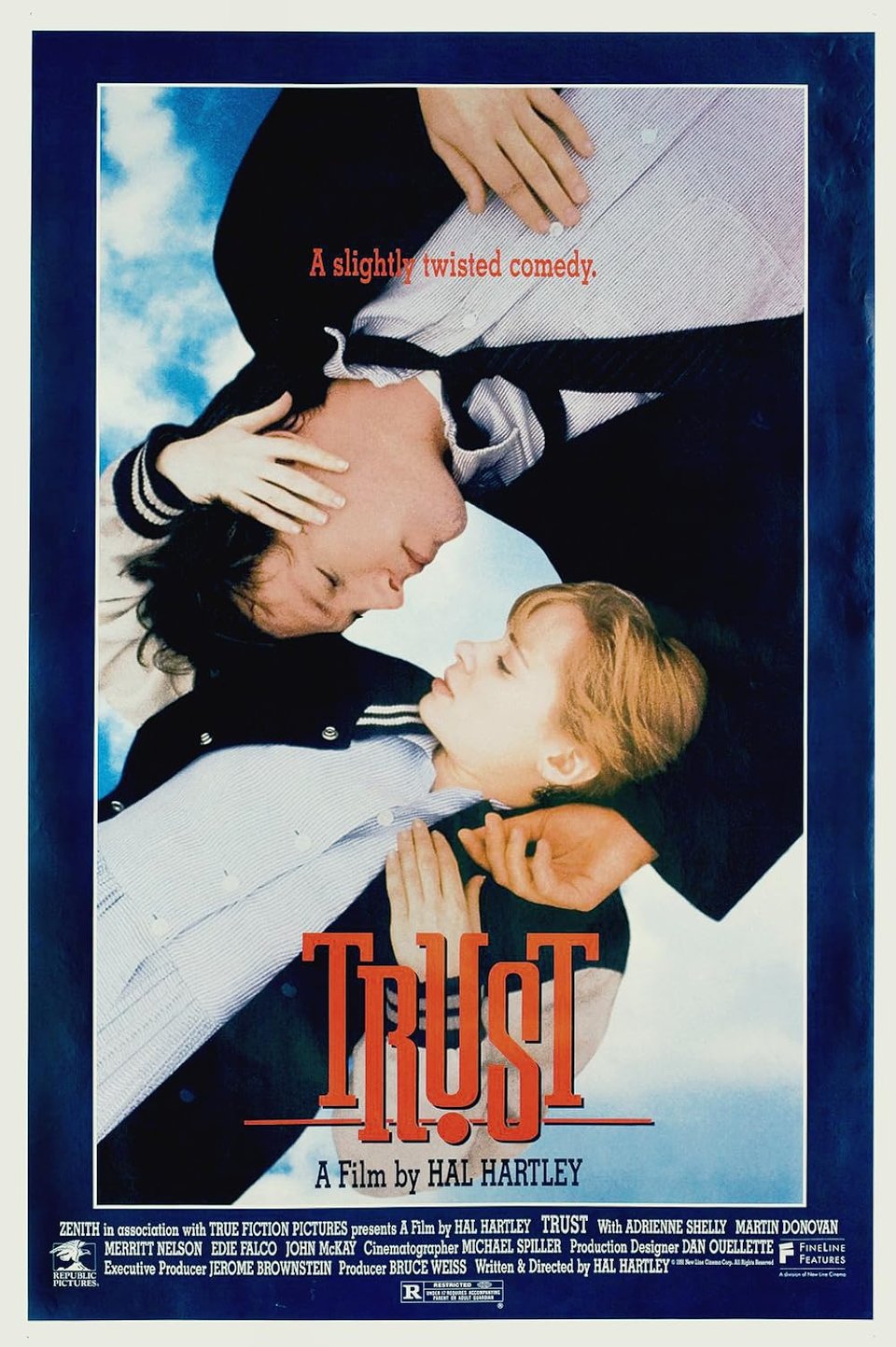
I don’t remember how Hal Hartley’s Trust appeared on my radar as a 13-year-old (a review in Premiere magazine?), but I do remember being fascinated by its poster, featuring two actors I had never heard of or seen before, Adrienne Shelly and Martin Donovan, and the tagline, “A slightly twisted comedy” (which in retrospect seems like the product of a marketing department throwing their hands up and going home for the day).
I didn’t know much more about the movie or its director, Hal Hartley, but somehow this image began to represent everything that film could be capable of but was out of reach to me at the time. I had to see it! So when it finally appeared in Toronto theaters, I dragged my D&D friend Cameron to the Capitol cinema on Yonge Street, fresh off its legendary, strange multi-year run of The Gods Must Be Crazy.1
We sat in the balcony. The theatre was otherwise empty, save for an unseen woman somewhere on the floor level who announced her presence with an occasional, loud cackle. Cameron hated the movie. My life had changed.
I’m still not sure what about this deadpan, philosophical comic drama, in which a pregnant teenager accidentally kills her father and meets a kindred spirit in the form of a jaded TV repairman, captured the heart of a relatively sheltered boy just barely past his Bar Mitzvah age. Maybe just the sense that movies could be something different than what I was used to, which was mainly watching Star Trek III: The Search for Spock and Enemy Mine as they played on endless repeat on Saturday afternoon TV.
Hartley isn’t nearly as remembered today as his other American indie film contemporaries of the ‘90s, and it’s hard to pinpoint his influence, if any, compared to your Andersons or Tarantinae. He’s been Kickstarting his productions and self-releasing his back catalog lately, and many of the discs, including Trust, are out of print. But I was fascinated, and a couple years later I remember lining up to see Simple Men at TIFF and actually shake the filmmaker’s hand after the screening, a moment that sort of sent me on my meandering course and still means something to me.

Trust holds up and I was delighted to see it in a theater again, with a group of people who wanted to be there, and who cackled at the appropriate volume. It’s funny, poetic and contemplative, its mannered dialogue somehow contrasting perfectly with its very down-to-earth Long Island setting. Edie Falco is in it! Adrienne Shelly is, if anything, even more of a great screen presence than I remembered, with one of those luminous, expressive faces the camera seems to have been invented for. I think she could have been one of the greats had she not been senselessly murdered in 2006. There’s now a foundation in her honour dedicated to supporting women filmmakers (in addition to acting, she wrote and directed the terrific 2007 Waitress, which later became a Broadway musical).
I wish I could tell you where to watch Trust, but sellers are demanding literally something like $700 for the Blu-Ray on eBay, and even the Criterion Pictures rep to whom I paid the license fee basically told me I was on my own. To find it, I had to dive into the treacherous waters of the internet, and a specific art-film website I will not name that I had not accessed in something like, no joke, 20 years. To unfreeze my ancient login, I had to plead my case to moderators in a chatroom somewhere on the dark web (or something like it), who granted me access again but sternly admonished me to be a better citizen in the future. So, in that spirit, I’m directing you to Vimeo on Demand, where you can rent the film for a small fee. But do it soon, as the service is closing down forever on November 20, as these things do these days, and all access to rented or even purchased films will be lost. (This is why the unnamed website above, and the like, need to exist.)
Last weekend I saw Chronovisor at the Festival du Nouveau Cinéma, and from its opening minutes I knew I was in good hands, in fact, I knew that this movie was absolutely, extremely, my shit.
Shot on deliberately-underlit, grainy 16mm, the movie follows Béatrice, a Columbia philosophy professor specializing in memory and neuroscience, played by Anne Laure Sellier, as she uncovers a decades-old mystery: In the 1950s, an obscure Venetian monk and musicologist named Pellegrino Ernetti claimed to have invented a machine that allows the user to literally see the past. His story made a small splash in the Italian and European media at the time, until the man mysteriously disappeared, his “Chronovisor” allegedly disappearing into the Vatican’s archives at the behest of the Pope.
Most of the film takes place on the printed page, as we read along with Béatrice as she tunnels through the archives, the texts appearing in optically-printed translations that hover, glowing, over the originals. This is the only film I’ve ever seen with five translators in its opening credits, and the only film where the audience’s principal occupation is reading. It’s a brilliant stylistic strategy, and the film feels no less like a thriller for it. (When the camera isn’t pointing at old Italian magazines and obscure journals, we are mostly in darkened New York City libraries and reading rooms, always at night, with usually only Béatrice in the frame.)
After the film was over, we were marvelling at how perfectly the filmmakers and art department had recreated the print media of the 1960s and 1970s. That’s when I did a Google search for Pellegrino Ernetti and discovered something that I will not reveal here, but which changed my perception of the film completely. If you’re interested in obscure museums, Holy See-fi, half-forgotten memories of Italian cities, Umberto Eco, Jorge Luis Borges, or any other of our shared preoccupations at Something Good, Chronovisor is going to be up your alley.
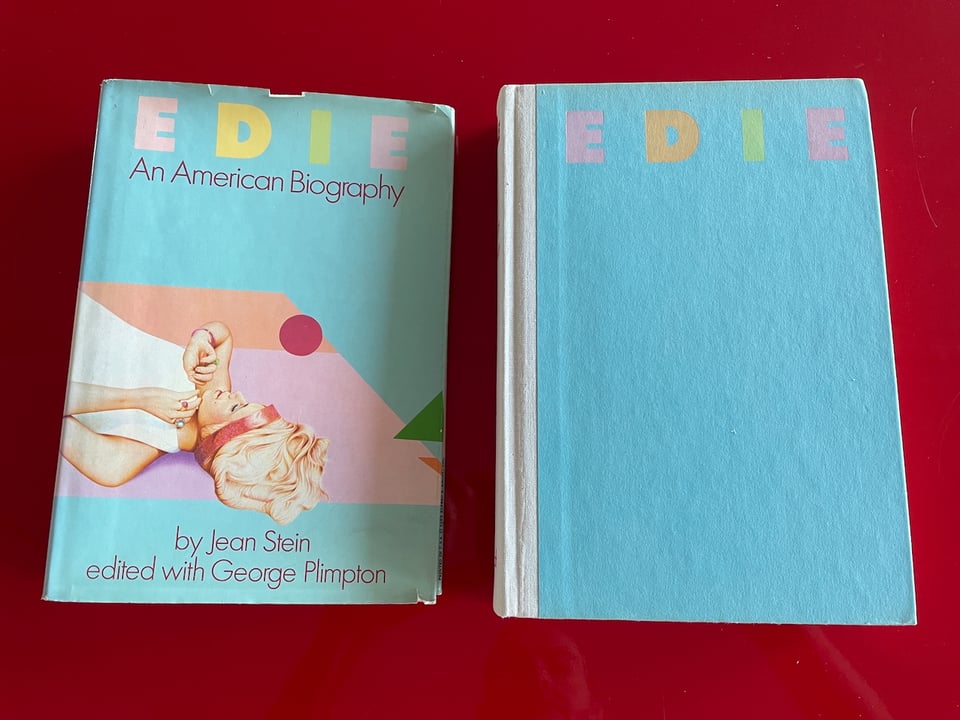
This week’s #nojacketsrequired comes via reader Mark Sullivan, and it’s a beaut. Reader, I encourage you to share your own discoveries, so please drop me a line.
Epigraph of the week:
Some can gaze and not be sick
But I could never learn the trick.
There’s this to say for blood and breath,
They give a man a taste for death.— A.E. Housman
From A Taste for Death, by P.D. James.
Bonus track:
This has been Something Good. If you like what you have been reading please tell a friend or subscribe below:

The details of this are a little obscure and very difficult to research; I encourage any readers who know exactly how long the film played at the Capitol and when to reach out. ↩
Add a comment: